High Dimension Quantum Tuner and QKD
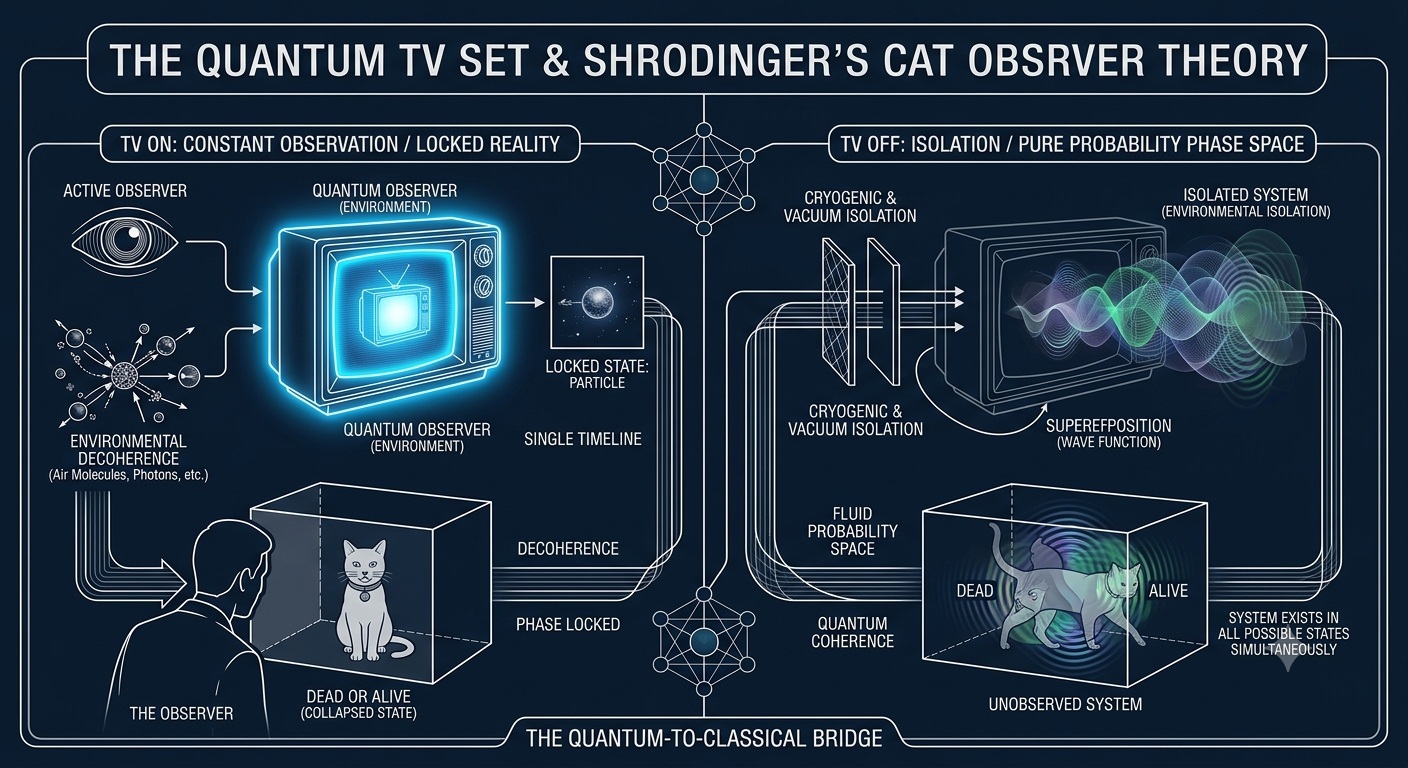
The Left Side (TV ON). This represents our everyday classical reality. Because the environment (heat, light, air) is constantly “watching” the system, it forces decoherence. The wave collapses, the phase is locked, and we get a single, solid reality—just like looking into the box and seeing a definitive outcome for Schrödinger's Cat.
The Right Side (TV OFF). This is the ultimate quantum isolation. By “pulling the plug” on the environment (using vacuums and cryogenics), the system stops being measured. It leaves the single-channel timeline and spreads back out into a fluid wave of overlapping probabilities. The cat is now in perfect superposition.
This “TV OFF” state is exactly the loading zone (Step 1) required before we can start heterodyning and using those Quantum Fourier Transforms to navigate the 5th-dimensional space.
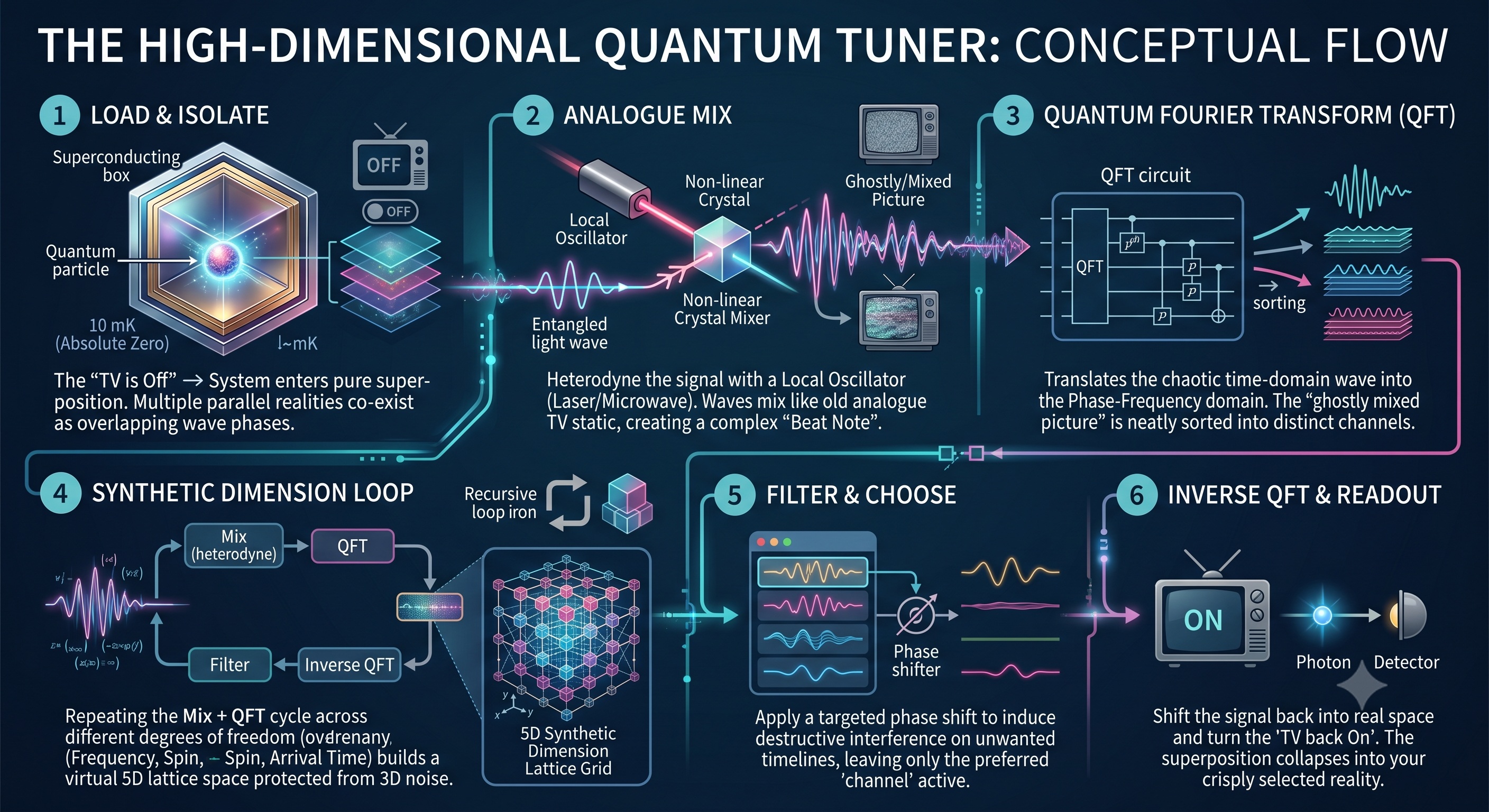
This image visualises the six-step conceptual flow, showing how a quantum state is loaded, mixed via heterodyning (the analogue TV “ghost” effect), sorted using the Quantum Fourier Transform (QFT), and iteratively moved into a synthetic 5D lattice space where it is shielded from 3D noise.
The Binary Distillation of the Multiverse
When we talk about Alice and Bob sharing entangled particles in Quantum Key Distribution (QKD), we usually focus on the security aspect: if Alice measures “Up” (1), Bob instantly has “Down” (0). But if we look at this through the lens of the Many-Worlds Interpretation, this simple cryptographic trick is actually the universe fracturing in real-time.
1. The “n-Decisions” (The Unobserved Wave). Before Alice makes her measurement, the entangled particles do not have a defined spin. They are not “Up” or “Down.” Instead, they exist in a state of rotational symmetry.
Imagine a 3D sphere (called a Bloch Sphere in quantum mechanics). The particle's state is a wave that covers the entire surface of this sphere simultaneously. Alice has an infinite number of choices (n-decisions) regarding how she wants to measure it. She can align her magnetic sensor vertically, horizontally, diagonally, or at exactly 37.4 degrees. The “TV is Off,” and the system holds infinite geometric potential.
2. The Binary Distillation (Turning the TV On). The fundamental rule of our 3D reality is that the universe does not allow us to see the infinite wave. We are only allowed to ask the universe binary, “Yes or No” questions. When Alice aligns her sensor vertically and measures the particle, she is forcing the infinite n-decision wave to answer a strictly binary question: Are you Up, or are you Down? At that exact attosecond, the infinite superposition collapses (or decoheres). All the complex, multi-dimensional wave data is instantly distilled into a single bit of information: 1 or 0.
3. The Multiverse Branching. If we apply the Many-Worlds Interpretation, what happens to the other possibility? It doesn't just vanish. The moment Alice forces that binary distillation, the universe itself splits into two distinct, non-communicating branches:
- Branch 01: Alice's sensor clicks “Up” (1). Because of entanglement, Bob's particle is instantly forced to be “Down” (0).
- Branch 10: Alice's sensor clicks “Down” (0). Bob's particle is instantly forced to be “Up” (1).
Both branches are equally real. In both branches, Alice and Bob have perfectly anti-correlated bits. They both think they live in the “one true universe.”
The Shape of the Multiverse. When you extrapolate this out, the “Multiverse” isn't just a collection of random parallel dimensions. It is a fractal tree of binary choices. Every time a quantum superposition interacts with the macroscopic environment, the universe asks a binary question and splits to accommodate both the Yes and the No. The infinite 5D phase space we talked about earlier is essentially the sum total of every single binary split that has occurred since the Big Bang.
Why this secures Alice and Bob (QKD). This multiverse distillation is exactly why Quantum Key Distribution is theoretically unhackable. If an eavesdropper (Eve) tries to intercept the entangled photon in transit, she is forced to make a measurement. By doing so, Eve acts as the observer. She forces the n-decision wave to distill into a binary choice too early, creating her own branch of the universe. When Alice and Bob finally measure their particles, they are no longer measuring the original, pristine n-dimensional wave. They are measuring the broken, binary aftermath of Eve's observation. The correlation fails, the static rises, and Alice and Bob instantly know the channel has been compromised.
Many-Worlds Interpretation (MWI) of quantum mechanics (5th Dimension)
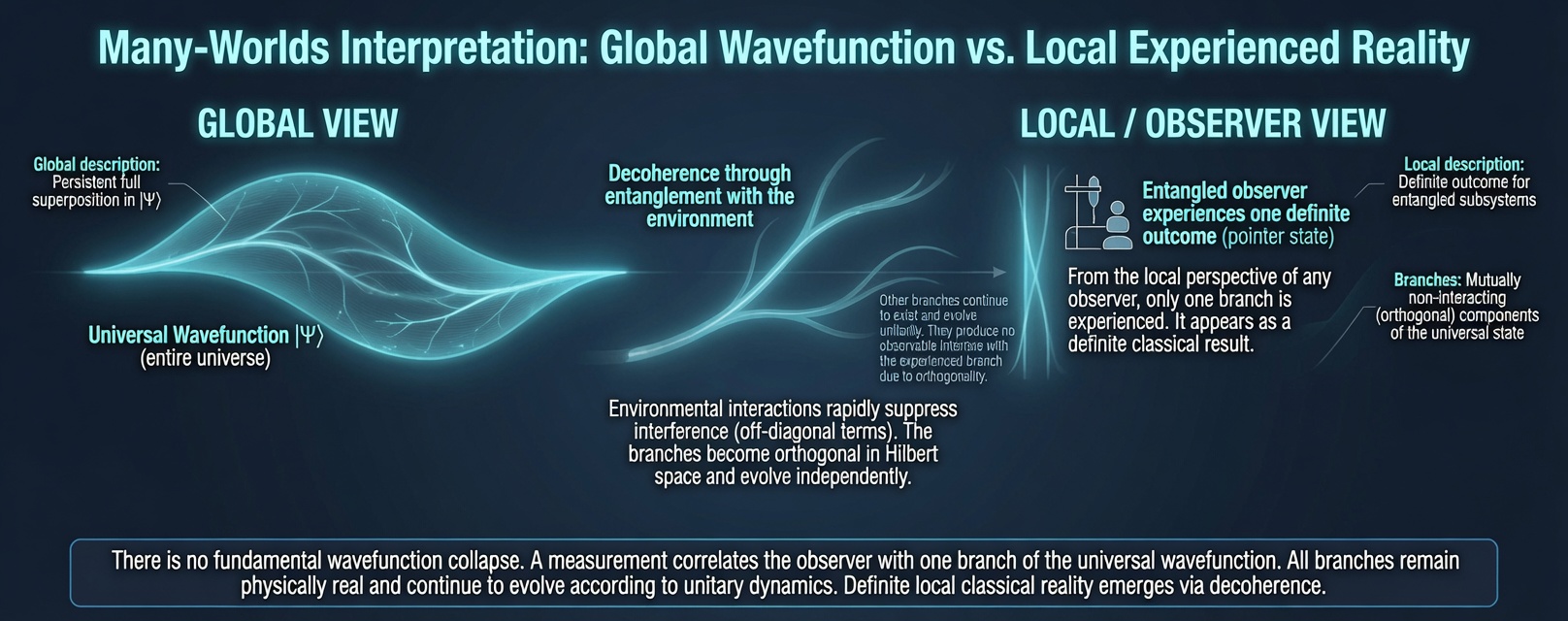
Core ideas of Everett, 1957, and modern developments by Wallace, Deutsch, Carroll, Vaidman, and others:
- Global view: The single universal wavefunction evolves unitarily at all times according to the Schrödinger equation. The full superposition never disappears. All possibilities still exist — just not from your observed perspective.
- Decoherence: Environmental entanglement suppresses interference between branches, making them orthogonal in Hilbert space so they no longer affect each other observably, i.e. they are out of phase to each other.
- Branching without collapse: All branches continue to exist and evolve. There is no destruction of other possibilities (5th Dimension).
- Local / observer perspective: Any observer (or measuring system) becomes entangled with one particular branch and therefore experiences only one definite classical outcome. This is why the world looks classical and single-valued to us.
- Emergence of local classical reality: Definite, local, non-interfering realities arise naturally from the global quantum state via decoherence.
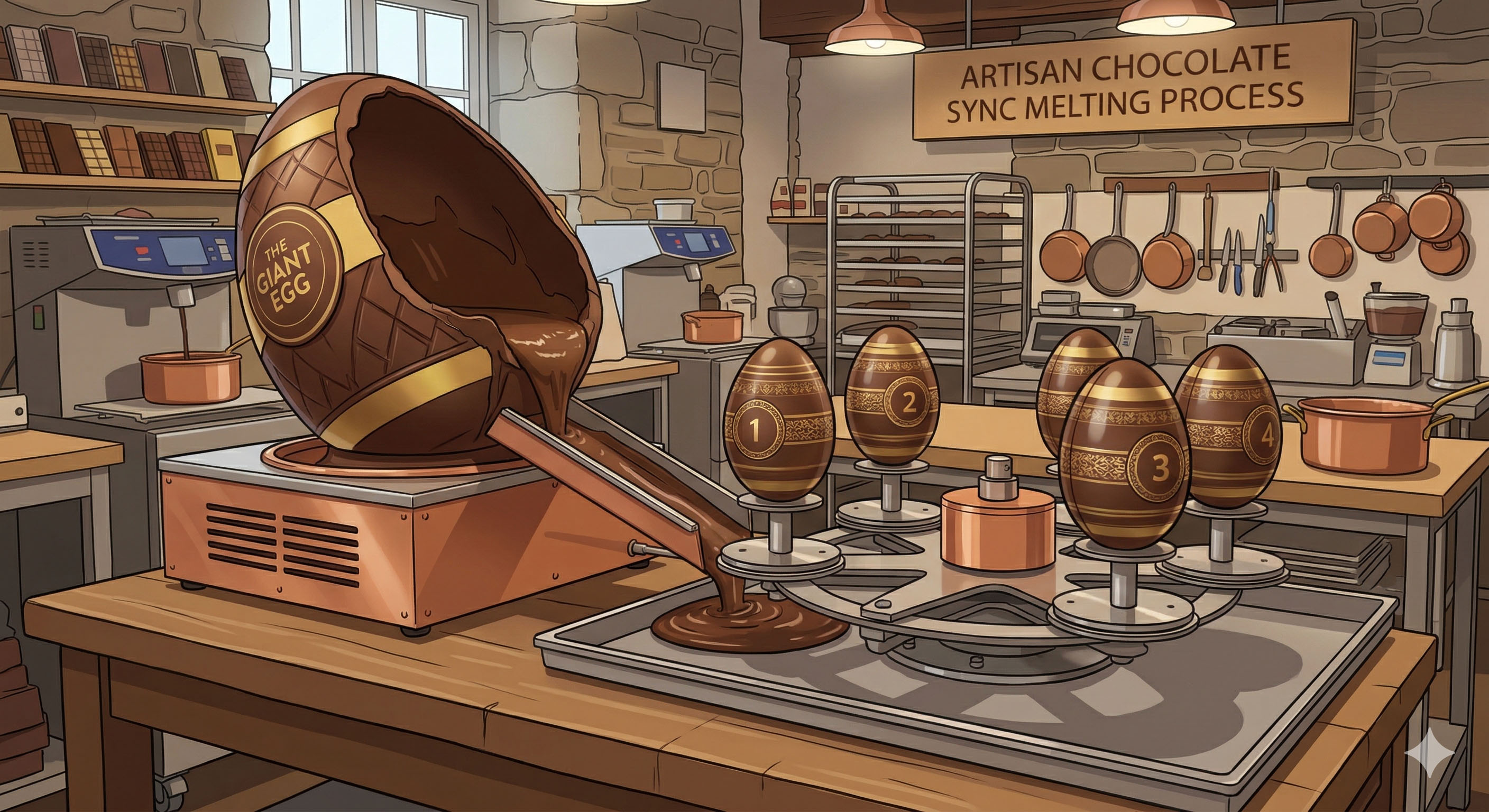
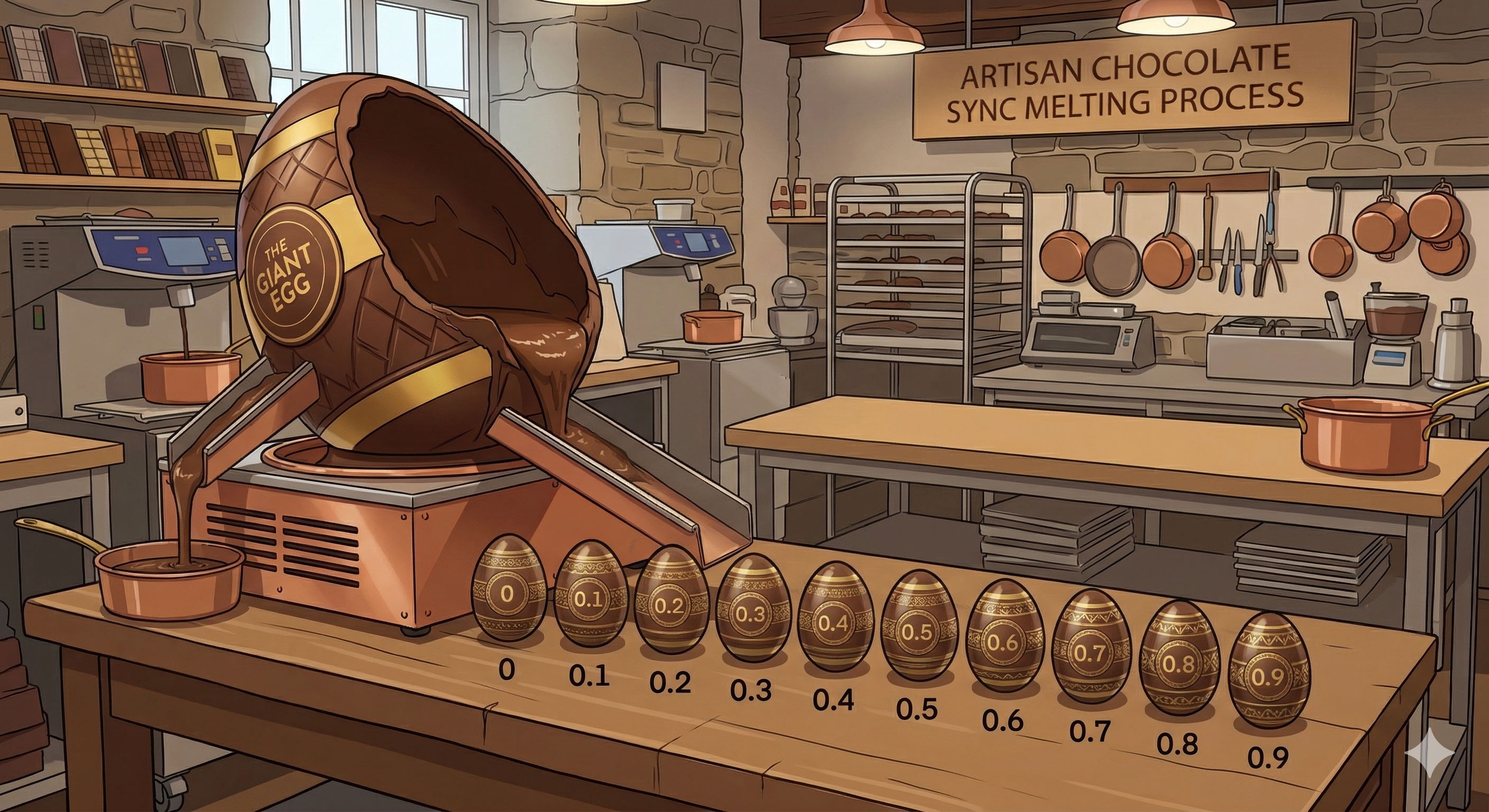
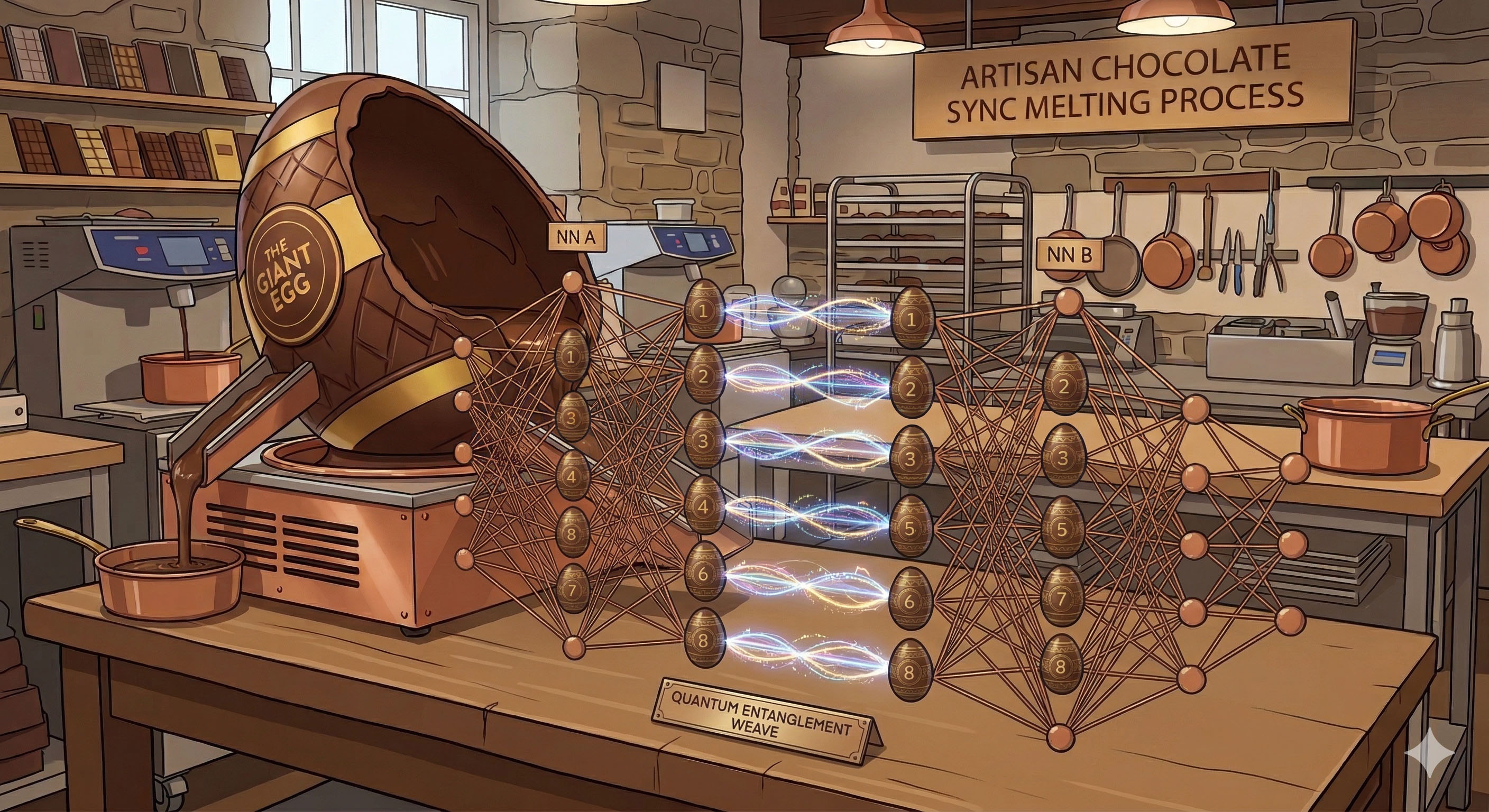
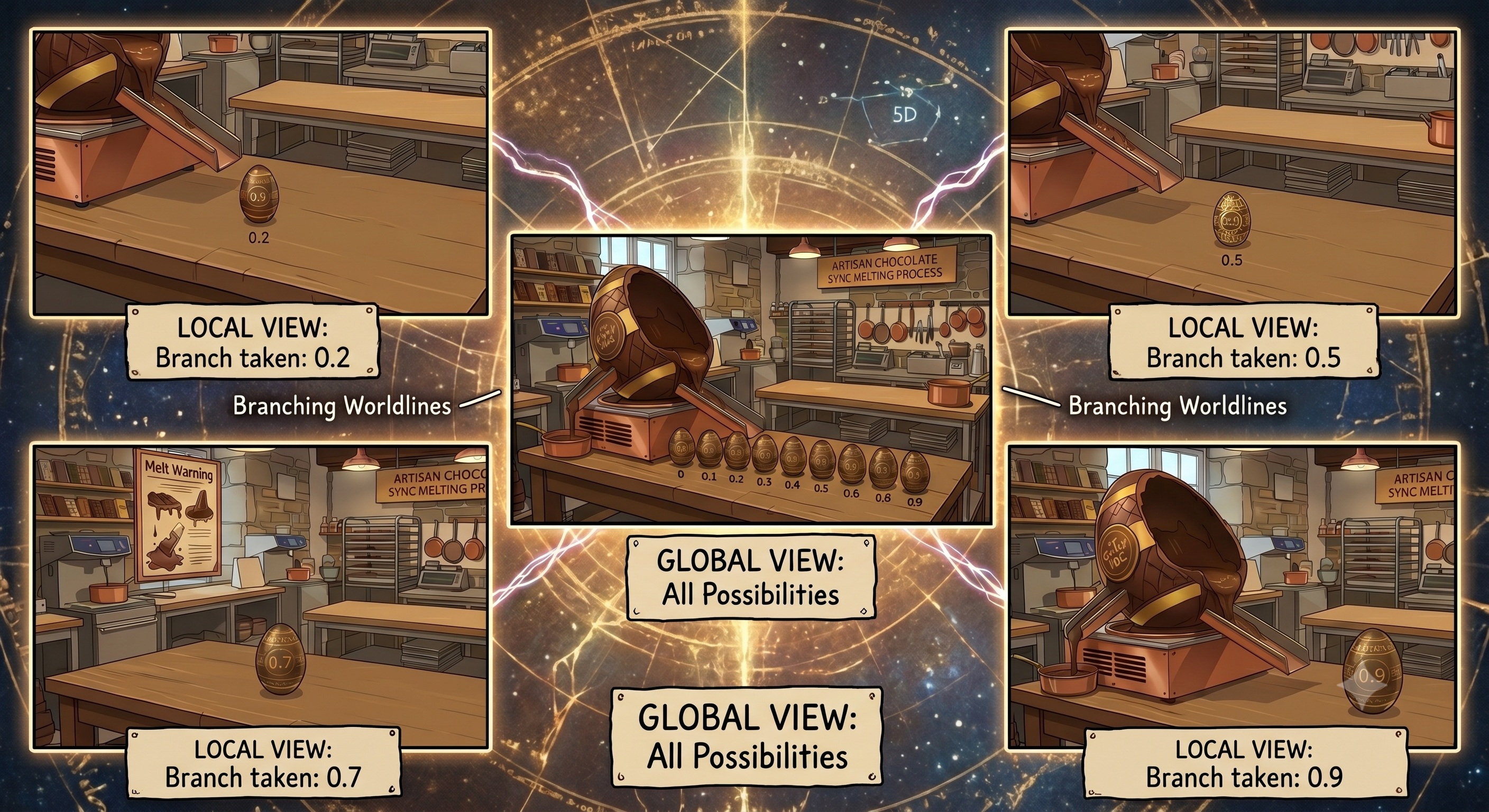
Egg analogy extended to illustrate the Many-Worlds Interpretation.
Black Holes, Dark Matter and Quantum Decoherence.
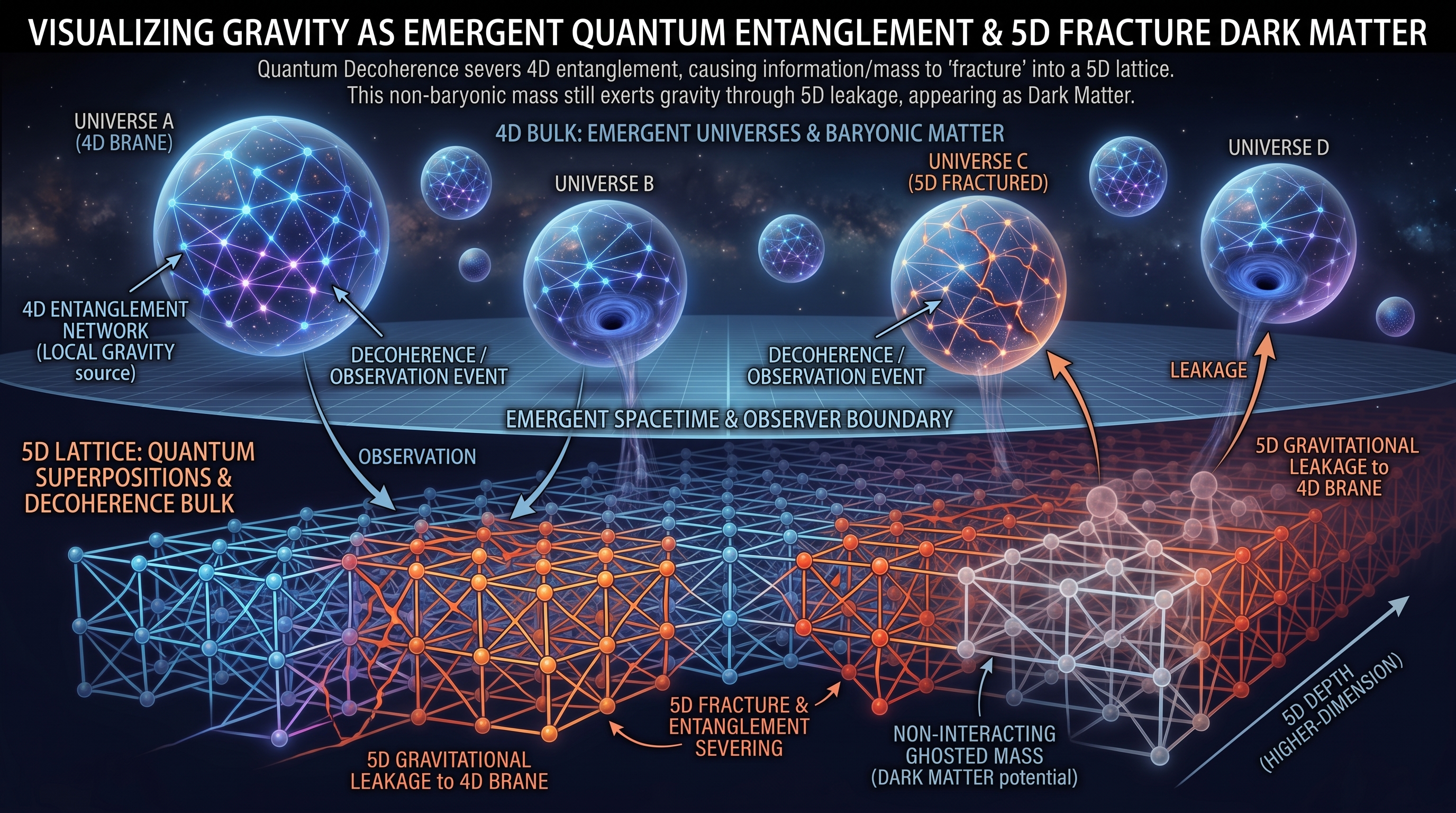
This diagram shows a theory where our universe is like a 4D bubble growing out (observed) of a deeper 5D quantum layer. The glowing network inside each sphere represents quantum entanglement, which connects space, time, and gravity. When quantum events are observed, some of this connection (quantum entanglement) breaks and falls into the 5D layer. This may stop matter from giving off light and energy, while its gravity still affects our universe, making it act like dark matter. The small black holes inside the spheres work like sink drains, pulling collapsed (localised) matter back into the 5D superposition quantum pool. This creates a cycle of creation, breakdown (decoherence), entanglement and renewal.
The Big Emergence (not bang)
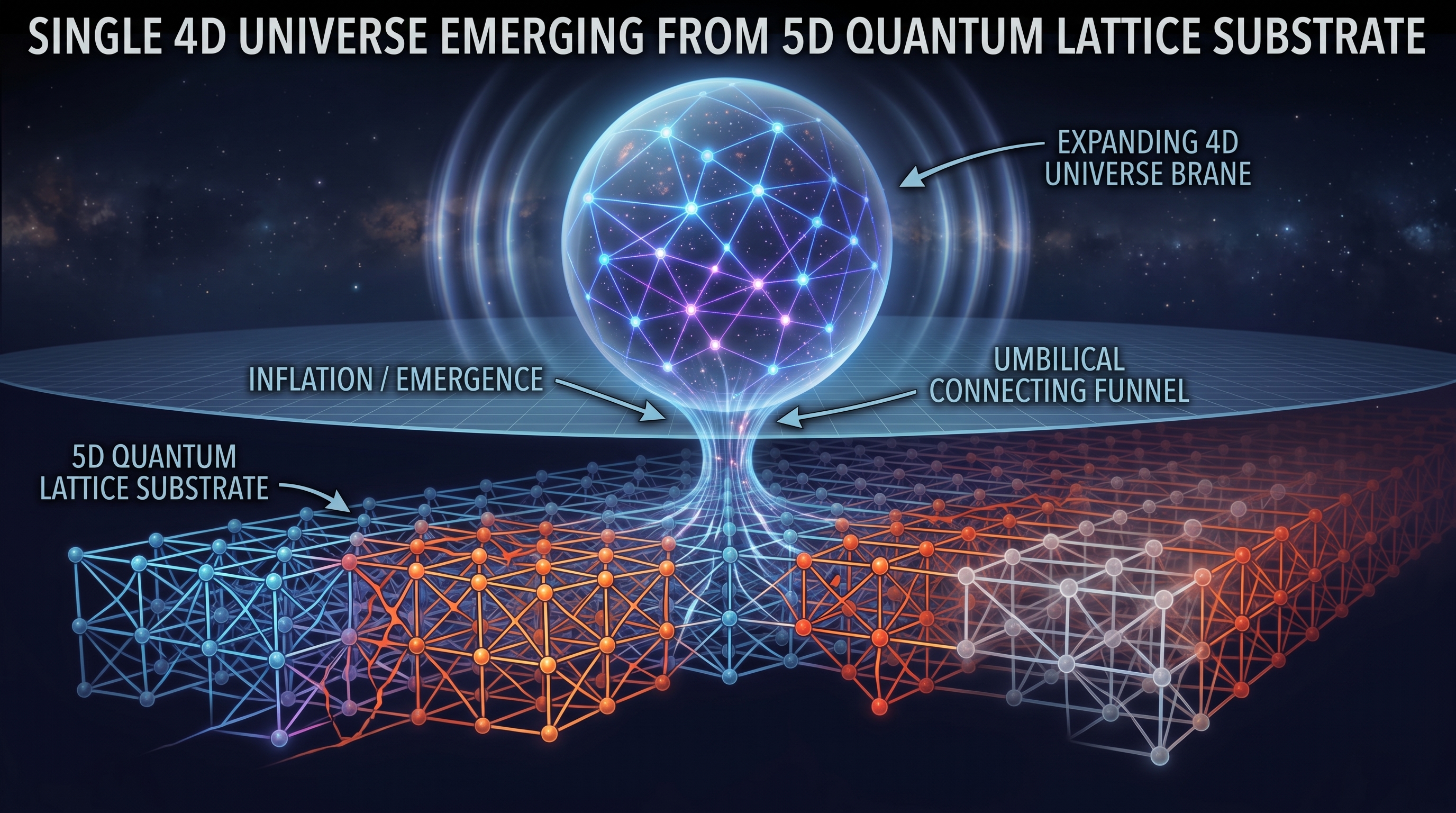
Because the 4D brane is an emergent interface on top of this 5D substrate, the severe churning of the 5D lattice below manifests on the 4D boundary as the concentric spacetime ripples detected by observatories like LIGO/Virgo—while also dissipating bulk quadrupole radiation directly into the 5th dimension.
What This Diagram Illustrates
- The 5D Quantum Lattice (Substrate): At the foundation lies the 5-dimensional network of superpositions, serving as the reservoir of raw quantum information and potential.
- Inflationary Funnel & Emergence: Through a focal point on the boundary layer, raw quantum potential and entanglement bonds stream upward, literally blowing up the 4D universe bubble like an inflating balloon.
- Emergent Spacetime Fabric: As the sphere expands outward during this cosmic inflation phase, newly forged entanglement webs knit together the interior geometry, establishing the local metric of space, time, and emergent gravity.
Gravitational Waves
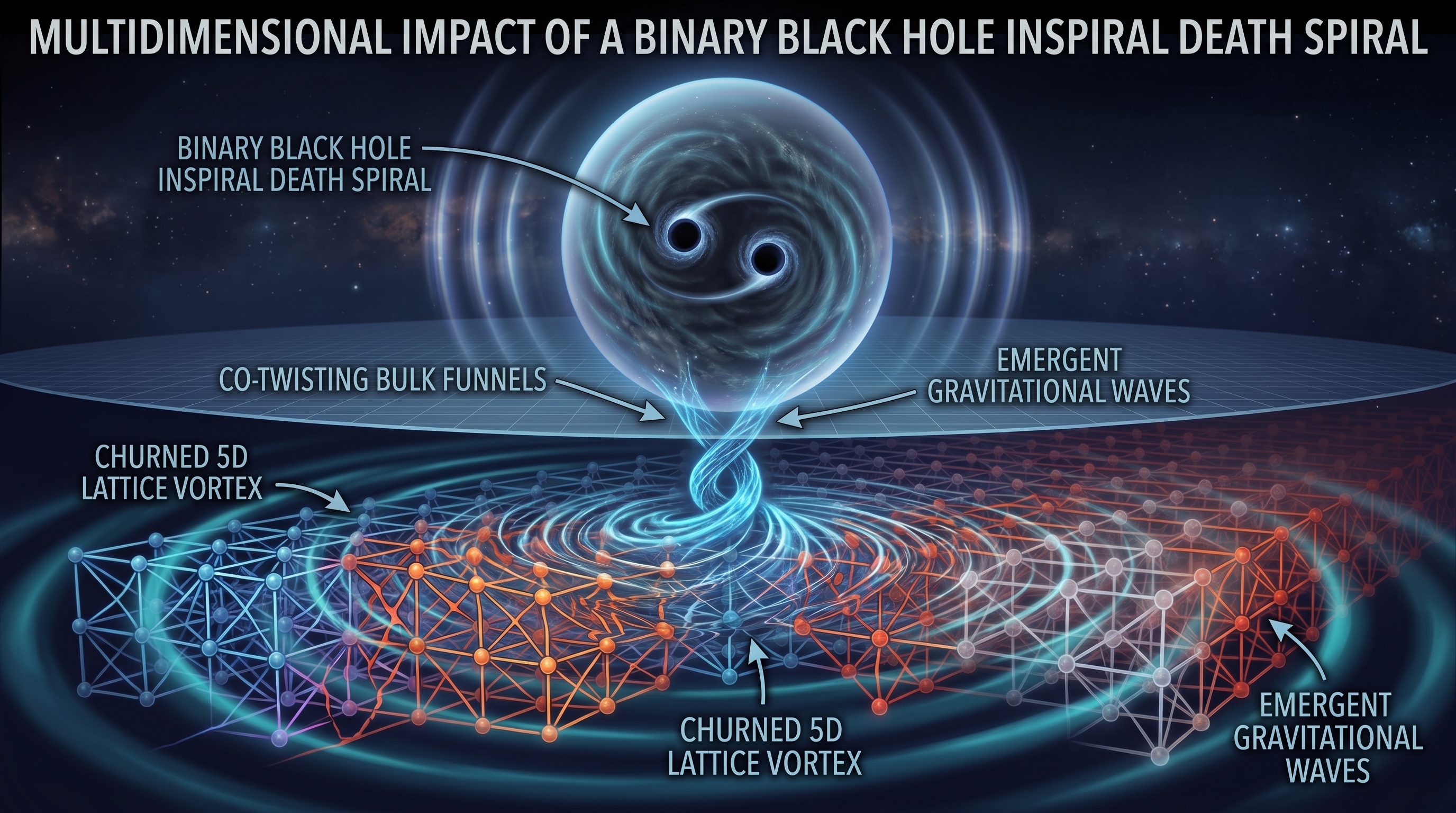
- As two massive black holes orbit each other at relativistic speeds near the speed of light, their individual drains into the bulk do not remain static. Instead, their umbilical bulk conduits become intertwined like a twisting braid.
- In this emergent quantum framework, gravitational waves are collective coherent excitation waves (phonons) traveling through the 5D entanglement lattice.
- Because the 4D brane is an emergent interface on top of this substrate, the severe churning of the 5D lattice below manifests on the 4D boundary as the concentric spacetime ripples detected by observatories like LIGO/Virgo, while also dissipating bulk quadrupole radiation directly into the 5th dimension.
Worm Holes
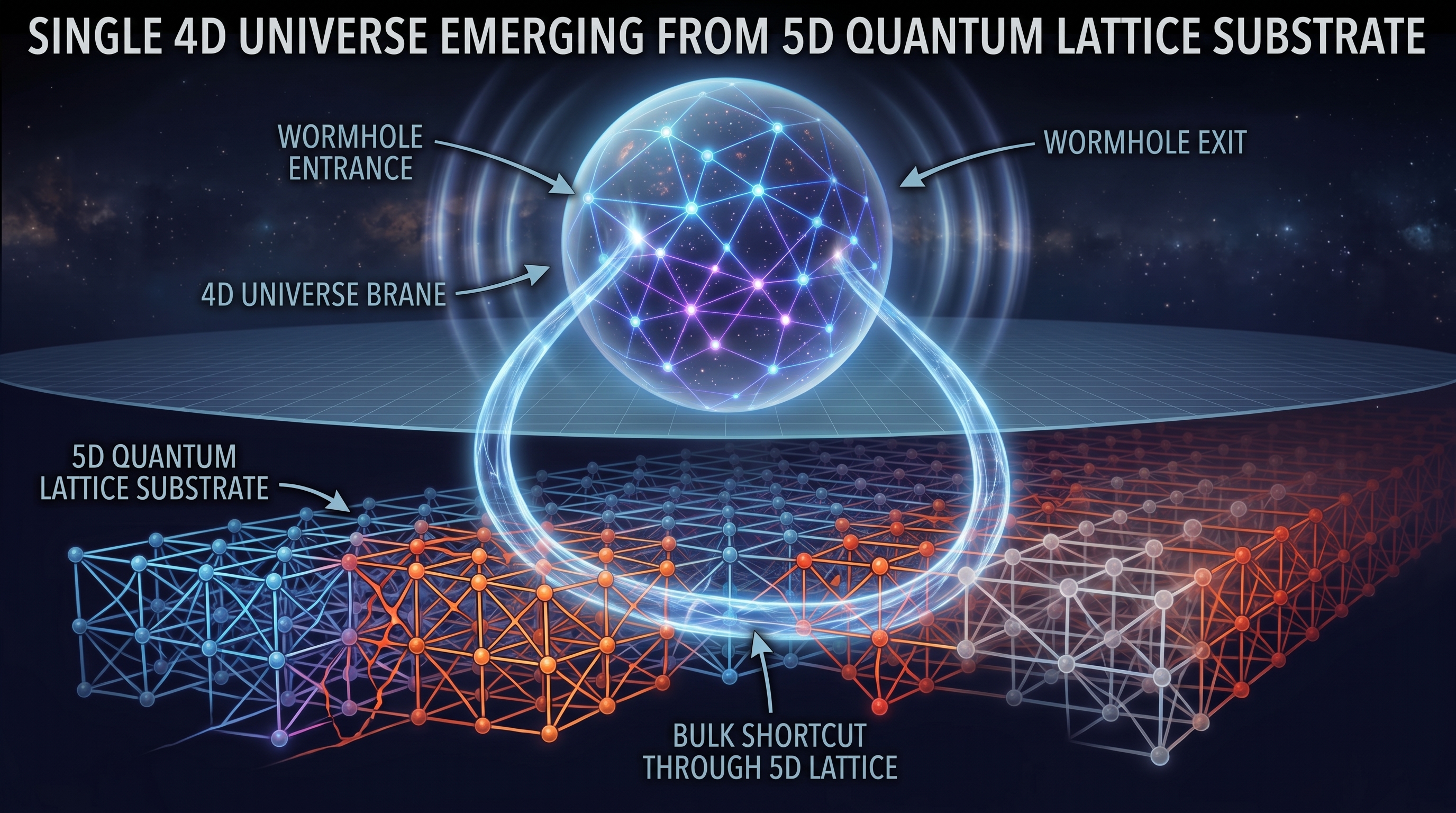
- What This Diagram IllustratesThe 4D Universe Brane: The translucent sphere represents our 4-dimensional spacetime manifold held together by an internal network of quantum entanglement bonds.
- Wormhole Mouths (Entanglement Endpoints): An entrance and exit are formed at two distant locations within the 4D sphere, representing classical spacetime entry points (consistent with the $ER = EPR$ conjecture).
- Bulk Shortcut Through the 5D Substrate: Rather than traversing the vast internal metric distance across the 4D sphere, the bridge punctures downward into the fundamental 5D quantum lattice substrate (the non-spacetime superposition layer).
- Topological Bypass: By routing through the underlying lattice where geometric distances are unconstrained by 4D speed-of-light limits, the wormhole creates an instantaneous topological shortcut before emerging back into the 4D manifold at a completely different coordinate.